-
Reality v. US/Western Propaganda Rubbish

On its back foot on all things Russia and Ukraine, the US-dominated collective West, its MSM press agents and Nazified Kiev persist in defying reality on the ground by falsely pretending otherwise.
According to the neocon infested Institute for the Study of War — a notorious Washington-based propaganda operation publishing state-approved talking points — Kiev regime troops are making “substantial gains (sic).”
Reality on the ground is worlds apart different from the above trash.
And this from AP (fake) News on Tuesday:
The collective West “rejected” accession treaties ratified by Russia’s Parliament — in full compliance with international law, the wire service failed to explain.
And this Russia-bashing fake news by Al Jazeera, saying:
Kiev regime troops “advance(d) in the south and east (sic)” while Russia’s parliament approved accession of Donetsk, Lugansk, Kherson and Zaporozhye.
And this WaPo fake news:
Approved accession treaties “violat(ed) international law (sic).”
And this NYT trash in its latest fake news edition:
Russia “d(oes) not know where borders are for new (republics and) regions (sic).”
“Russian forces (are) on the run (sic) across a broad swath of the frontline (sic).
Regime troops “pressed (their nonexistent) blitz offensive (sic) in the east and made gains in the south (sic).”
The above trash and daily volumes more reflect how the public mind is manipulated throughout the US/West by MSM fake news rubbish — truth and full disclosure banned on key issues.
Last week, CNBC reported a rare kernel of reality about US/Western war on Russia by use of expendable Ukrainian foot soldiers, saying:
The collective West is “running out of weapons to send to Ukraine.”
Ramping up production may take place but it’s no quick fix or simple task.
US merchants of death, mass destruction and human misery produce about 30,000 rounds of 155 millimeter howitzer shells annually.
Ukrainian Nazi and conscript troops expend that volume in about “two weeks,” said CNBC.
According to US National Defense University’s senior military fellow, Dave Des Roches:
“Unless we have new production, which takes months to ramp up, we’re not going to have the ability to supply the Ukrainians.”
And this from the EU’s so-called foreign policy chief, Borrell, saying:
“Military stocks of most (European NATO regimes (have been) depleted in a high proportion.”
Hegemon USA nearly exhausted its supply of 155 howitzers and shells — except for what’s reserved for its own forces.
And this reality check from retired marine corps colonel/senior Center for Strategic and International Studies advisor, Mark Cancian:
“There are a number of systems where the (US war department) reached levels where it’s not willing to provide more of that particular system to Ukraine,” adding:
Hegemon USA “needs to maintain stockpiles to support (its) war plans.”
“For some munitions, the driving war plan would be a conflict with China over Taiwan or in the South China Sea.”
“For others, particularly ground systems, the driving war plan would be North Korea or Europe.”
The empire of lies and forever wars is “limited” in how many HIMARS, Javelin and Stinger missiles, as well as M777 howitzers and 155 mm shells it can supply to Ukrainian Nazis and conscript troops.
It takes one to four years to boost weapons production significantly, Cancian stressed.
Last spring, Lockheed Martin spokesman, Jim Taiclet, said the following:
It takes “6, 12 to 18 months” to deliver weapons once “our supply chain (is) ramped up.”
Left unexplained by CNBC and other MSM is how much in the way of arms and equipment supplied to the Kiev regime is destroyed by Russian forces.
In stark contrast, analyst Helmholz Smith explained the following:
Russian videos show “trains carrying heavy equipment west.”
“I’ve seen tanks, Mstas, BM-21s, Iskanders and lots of BMPs.”
“Nothing suggests that Russia is running out of anything.”
“This suggests preparations for a large-scale Russian Army armored offensive along traditional deep penetration doctrine.”
“The status of four new regions opens the possibility of more forceful actions by the Russian Armed Forces because they are defending the Motherland.”
“There is a good deal of plausible speculation that the 300 thousand man call up may free up soldiers in the rear.”
“If so, the effect of extra troops may be felt sooner than many expect.”
And if a winter campaign follows, Russian forces are well-equipped, trained and experienced in frigid weather fighting.
And this reality check posted by military analyst Andrei Martyanov, an analysis by an individual identified as Larch, saying the following:
“Putin set the goals of the SMO.”
“The demilitarization of an enormous military, stocked for eight years and restocked feverishly from the bases and warehouses of 30 countries in NATO, is going very well.”
“The Ukies had 750,000 men in trenches and fortified positions and embedded in big cities, shielded by civilians everywhere from Kiev to the smallest settlement in Donbass.”
“Ukraine had a significant air force and stout air defenses with BUKs and S-300s in large numbers.”
“The Russians reduced this order of battle markedly.”
“The navy of Ukraine is gone. It has no functioning naval bases.”
“The Ukie air defenses have been reduced to mobile radars and a few extant S-300s.”
“The most effective air defense they have is the tactic of massing MANPADS and receiving real time alerts from NATO of oncoming Russian jets and helos.”
“This has not stopped the Russian aerospace forces, though it is a hampering defense that has to be recognized as a threat.”
“The Ukie air force is 95% gone, only replenished from NATO with aircraft that stay in the battle for minutes before they are reduced to losses.”
“Over 500,000 Ukies are gone, dead and forever off the battlefield.”
“Thousands of mercs have been killed or chased off the battlefield.”
“The entire junior officer echelon of Ukraine is gone.”
“US and NATO officers are the tactical commanders, as communications in the battlefield document.”
“American and British voices give the commands. Videos are available as proof.”
“Every strategic offensive launched by Kiev (and NATO command running its military) has been destroyed.”
“The only ground they gained was ceded in order to draw the Ukies into the open or to reposition Russian forces to better lines of defense.”
“The Ukies lost forever Mariupol, Kherson, Melitopol, all of Lugansk, 65% of Donetsk, their access to the sea (except with Russian permission at Odessa), the air space over most of Ukraine, and sovereign control over their utilities and transport systems which exist only as long as the Russians allow.”
“Ukraine is under its 4th total mobilization.”
“By winter’s end it will have lost another 100,000 of their cannon fodder.”
“Likely, too, they will have lost what they hold in the Donetsk oblast.”
“The Russians have done this while exposing only 15% of their military.”
“It is clear from signs in Chechnya that (General) Kadyrov could gather 100,000 extra men who want to join Chechen forces from the Caucuses and other brotherly Muslim lands.”
“There are also ample signs that Syrians and some African fighters want to join Russia in the battle against the hegemon.”
“Another 100,000 foreigners could easily be brought to Ukraine, if needed.”
“Russia has enormous depth of reserves beyond its own manpower potential.”
“What (Russian) generals have done is send steel and explosives to demilitarize Ukraine.”
“Artillery, bombs, rockets and missiles are fighting the war, saving Russian manpower while decimating Ukie force structure.”
Things are “going very well for the mission Putin set.”
“Ukraine will be destroyed and NATO will have no proxy.”
“NATO will have to send its own manpower.”
“That stage of warfare will fracture the alliance.”
“The US will have to coerce a new proxy force to fight Russia out in the open sectors of Ukraine.”
“They won’t be in fortified positions. And they won’t have civilians as shields.”
“If the US manages to spread war into Poland and Belarus and Moldova, a few hypersonic missiles from Russia will quench the enthusiasm of those NATO countries, and Russia will join with Belarus in an overwhelming punishment of Poles and Baltics.”
“If Kaliningrad is touched, the attackers will lose their capitals and HQs.”
“What the Russian military has not done does not indicate what (it’s very much able to) do.”
“Strategically, the SMO is very successful.”
“Pulling out of Izyum and Lyman are blips that don’t even factor in the military scheme of things.”
As was expected today, once facts (are revealed), the scale of failure of (so-called Kiev) offensives become clear.”
The above reality check is worlds apart from daily propaganda rubbish by US/Western regimes and their MSM co-conspirators.
A day of reckoning awaits them.
-
Germany (and Europe) on the Brink- The bloom is off Europe’s former economic powerhouse Germany.

The bloom is off Europe’s former economic powerhouse Germany.
Last month, the German Retail Association (HDE) reported that consumer sentiment reached an all-time low in August — then declined further in September.
It’s because of increasingly unaffordable energy, food and other essentials while disposable household income is declining.
As a result, consumer purchasing intentions also plunged to an all-time low.
Looking ahead, there’s nothing positive in prospect, gloom and doom alone at least through winter — most likely much longer.
In late September, Spiegel International reported the following:
“Germany is expecting tough years ahead with diminishing prosperity, a shrinking middle class and growing inequality.”
“This is uncharted territory for the government and society, and both are facing some difficult choices.”
When middle class Germans are increasingly hard-pressed to make ends meet, “things start getting dicey everywhere in the country, particularly for the” ruling regime.
A combination of soaring inflation, unavailability of vital gas from sabotaged Russian pipelines, public anger over growing deprivation and self-inflicted harm by allying with hegemon USA’s sanctions and hot war on the Russian Federation, Germany faces a perfect storm with no resolution in prospect.
The latest news is shocking!!!
Experts predict that an EMP strike that wipes out electricity across the nation would ultimately lead to the demise of up to 90% of the population.
However, this figure begs an important question: if we were able to live thousands of years without even the concept of electricity, why would we suddenly all die without it?

And this Spiegel reality check:
Q II real wages fell by 4.4% year-over-year while prices of energy, food and other essentials rose sharply.
Likely already in recession, there’s “growing evidence that it could become particularly severe – with a tenfold increase in the exchange electricity price, numerous corporate bankruptcies and a permanently damaged economy.”
According to economist Michael Fratzscher, Germany is in decline.
Lost prosperity will likely be permanent.
After nearly two decades of economic growth, scant unemployment and rising household incomes, “a tough decade is looming” ahead, he believes.
Former German finance minister, its current chancellor, Olaf Scholz, presented no viable plan for turning things around, just tinkering around the edges.
Instead of using Germany’s financial resources to aid struggling enterprises and households, the nation’s war minister, Christine Lambrecht, vowed on Saturday to supply Ukrainian Nazis with more arms, equipment and related military aid.
Weeks earlier, Scholz vowed to provide its regime with Germany’s “most modern and efficient equipment” soon — in support of hegemon USA’s forever war on Russia.
It’s at a time when vital homeland needs are going begging.
Like Europe overall, Germany is increasingly becoming a thirdworldized economic backwater.
While campaigning to become German chancellor, Scholz vowed to deliver greater societal fairness.
Instead, public misery increased since he took office last December.
According to economist, Timo Wollmershäuser, we’re in unchartered territory at a time when hard times getting harder are driving large segments of German society into poverty.
What’s going on isn’t a conventional economic downturn.
“The future viability of the German economic and social model is at stake.”
The same reality applies to Europe across the board.
Can industrial Germany survive without reliable, affordable Russian energy?
Instead of being Europe’s economic powerhouse, it’s now a laggard.
It’s at a time when according to the German Institute for Economic Research:
The wealthiest segment of German society, its top 10%, owns over two-thirds of the nation’s assets.
In stark contrast, the bottom half of the population is struggling with a meager 1.3% — at a time of a declining middle class.
According to Sociology Professor, Heinz Bude:
“(D)ecline in purchasing power will become the major issue for populists in Europe.”
Last Friday, Spiegel reported that thousands of German stores face bankruptcy, citing an assessment by the German Retail Association.
According to economy minister, Robert Habeck, “exploding energy costs (created) existentially threatening” conditions for around 16,000 German enterprises.
With energy costs nearly 150% higher since end of 2021, they’re losing money instead of earning enough to remain solvent.
With millions of hard-pressed German households struggling to afford the high cost of energy and other essentials, does a winter of discontent loom in Germany and across Europe?
The most shocking article can be found below.
Liberal’s hidden agenda: more than just your guns…
… the impending collapse of the US food supply system
will steal the food from your kids’ tables…Watch this video below to find out the great secrets hidden by the government.

-
The Best Emergency Food Methods For Keeping Your Family Alive Surviving the Coming Collapse
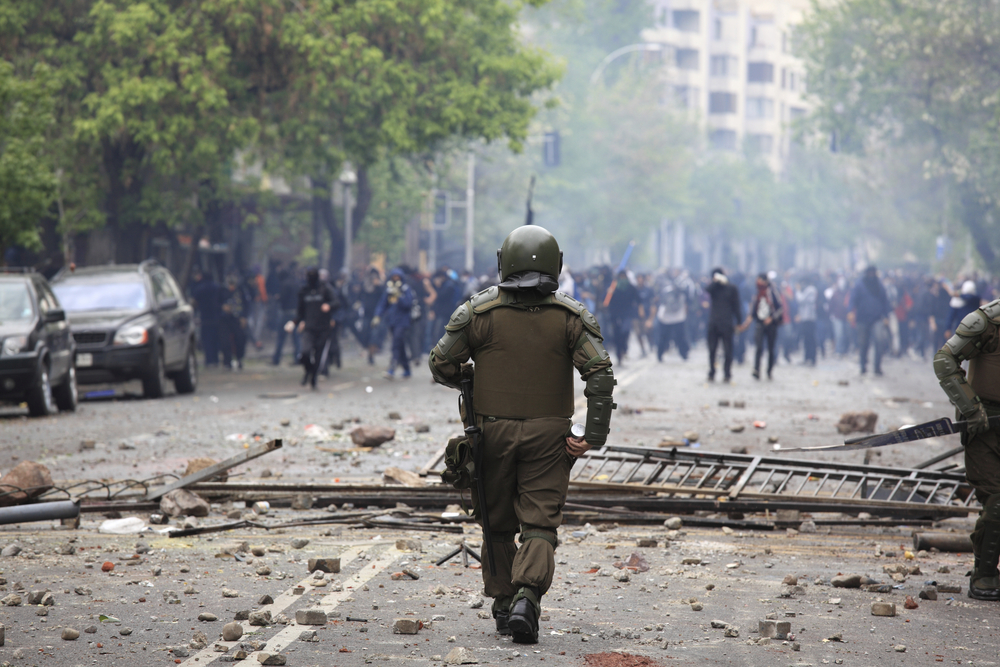
A second catastrophe promises to follow in the foot steps of a first — it’s a catastrophic food shortage. The time to prepare for that is now.Lessons passed down by expert preppers on storing up emergency food on a budget…
Emergency foods are something that families, church and relief organizations, schools, institutions, and food banks should be stocking up on nowadays, while it’s still possible, while there’s still food to be had.
Our nation is sitting on a ticking time bomb and we unfortunately cannot tell exactly when this bomb is going to finally detonate. But we can hear it ticking. Louder with every passing year. Yet, no matter how frantically government and the military work to defuse the bomb, defusing this bomb continues to elude them. Of course I’m using an analogy to describe some serious crap hitting the fan.
When it does, we are looking at a famine on a level that this world has never seen before.
Nationwide Food Shortage And Then —
Famine. No more food coming in from anywhere.
What if the day comes where stores never re-open? At the point where your survival food stores become exhausted after several weeks following a collapse, you’re either going to have to turn to begging for food, or a very difficult and frustrating life trying to hunt, fish, trap or forage in the adjacent forests — called living off the land — but truly, only the adept, the knowledgeable, and the experienced are going to be able to “live off the land” and the ones who do won’t be found in any nearby woods or hills.
Because there won’t be anything to hunt or forage for in the nearby woods or hills following a major disaster.
Wildlife is very sensitive to the presence of people.
So a large number of people fleeing into wilderness regions is going to send much of the wildlife fleeing for remote regions. It’s these remote regions that the hunting can be good; but only the most adept are likely to make it that far where there are no roads, where there may be rugged mountains and canyons and rivers to cross; there may be dangerous weather conditions to deal with depending on the season. If you can make it to a remote region, I’m talking really remote, it will be possible to live off the land, but it won’t be easy.
Are You Just Fine Right Where You’re At?
In a worst case scenario, we may see martial law, a government collapse, a civil war of sorts. Our nation weakened, it’s defenses obsolete, it’s critical infrastructure all but destroyed, a scene from Red Dawn (I’ve referred to this movie in another article) may play out in a number of communities. Are those Russian jets in the skies? Are those parachuters dropping down onto main street, Chinese or North Korean? The sky is full of them. The clouds were a perfect cover when radar defenses on the ground were no longer working, having been fried by the EMP that had first wrecked America’s power grid six months back.
Parachuters are landing in residential neighborhoods. Quickly gathering up parachutes. Quickly checking weapons and gear. Firing at people who had been watching it all unfold from front yards and porches.
Who’s cargo planes are landing at the local municipal airport with tanks and military vehicles streaming out? Chinese symbols. Russian symbols. What the hell is going on?
Hopefully That’s Not Your Community
But it may be more than one community at some point. It’s very possible that your community will make it through the weeks and months following a collapse that we can feel in our blood and in our bones is heading America’s way some point soon. We can see the signs in the heavens and the earth, I believe, that Jesus warned about when he was here and told us to be on the watch for. Impending judgment. We were told, and cautioned as Christians, to watch for it. When we see it, we will know. It’s almost like Yoda talking to Luke Skywalker in Star Wars, telling Luke he will know the time when the time is the right time. What Yoda? That makes no sense. On reflection though, Luke finally one day figures out what Yoda was telling him. What is the Lord telling us right now through the Spirit? For the unbelievers out there, who don’t yet know God, for a Christian this essentially means what is God leading us to do or prepare for without using words to tell us?
Some Of Us Should Be Stockpiling Food
Some communities, some neighborhoods, some small towns and cities will likely make it through the first few months following a collapse relatively fine, all things considered. Other’s won’t do so well and will be very dangerous places to live.
You’ll need some friends, you’ll need some fire power, hopefully God is on your side with all that fire power and he’s going to use you in some way to make a difference, for good. The violent hand of God is something we see repeated in Old Testament chapters of the Bible. I expect it’s something we’re likely to see again some day. There’s just too many examples of God going to war through his people, though not all of them of course, just a few at a time. Because if God used too many people, to give the enemies of Christ a beating, they might make the mistake of thinking that they did this by their own power. That’s not God’s style in the Bible though. That’s not the pattern we see in scripture.
Who remembers this phrase? “Saul has slain his thousands, and David his tens of thousands.”
When God favored the Israelites, the Israelites were successful at wiping out enemy nations, success after success after success.
But when God was angry with the Israelites, over rebellion, over disobedience, over wicked acts and atrocities, just the opposite happened. The Israelites were overrun, beaten down, many killed, many more ended up enslaved to other nations.
That first part sounds a lot like America. At one time we were a nation under God. Success after success. Innovation after innovation. Dreams and bigger dreams. America had God’s favor and was the gem of the world. People from around the world dreamed of moving here and many did. But today America no longer has God’s favor. We have become God’s enemy. Not all of us. But a lot of us.
Jesus warned the wheat would be separated from the chaff. If you don’t know what he meant by this, you better figure that one out fast. If should be the first thing you do before you do anything else in life.
What the hell did Jesus mean when he said he would seperate the wheat from the chaff? There’s nothing difficult with that statement. So why do so many people have a hard time grasping those words?
They just don’t care.
Tick.
Tock.
Time’s up.
How Long Will Your Emergency Food Last?
If disaster struck today, how long would your stockpile last? Careful, it’s a trick question. I’m not asking how long you would be able to live off your stockpile — I’m asking about the actual shelf life of the foods in your basement or pantry.
Though you may have beans and cereal that, in theory, can last 10 years or more, the way you store them can substantially decrease or increase that amount. In other words, you may have quite a bit of food in your pantry right now that has less than a year until it expires… and that’s a tough position to be in if a serious, earth shaking disaster struck today.
The Scoop On Emergency Food Storage
Extending The Shelf Life Of Several Foods
Food storage done right, so you can double, triple or even quadruple the shelf life of your foods. Let’s talk about that for a moment. It all starts with the 5 food storage enemies: Oxygen, moisture, temperature, light and pests. The 6th one is time but there’s nothing we can do about that except rotating our stash. Now, if you’re looking to get 10, 20 or even 30 years of shelf life off your foods, you need to tackle all of these enemies. No exception.
Extending The Shelf Life Of Grains, Beans And Rice
Grains, beans, white rice… These are some of the foods with a long shelf life preppers like to stockpile that are also cheap. However, not all varieties are worthy to be in your stockpile.
For example, Cheerios and other breakfast cereals you typically buy at the supermarket have a shelf life of 6 to 8 months. Processed cereals have many refined and hydrogenated oils in them, oil goes rancid so, even if you were to use the preservation techniques we’re going to talk about in a minute, it still wouldn’t be worth it. Thus, step one in storing your food for a really long time is to pick the right food. When we’re talking about real long term emergency food storage, opt for storing white rice (not brown), dried beans and whole wheat berries (not breakfast cereals); rice, beans and wheat berries should be the staples of your survival stockpile.
Mylar Bags With Oxygen Absorbers For Storing Emergency Food
The best way to store your emergency food is in Mylar bags with oxygen absorbers. This is a no-fail combination used by most preppers, provided your food is dry before you store it. Otherwise, you can wake up with condensation after you seal the package — not a good thing.
The process is simple. You fill the bag nearly all the way to the top, seal it using an iron or a hair straightener (but not before you add a pack of the oxygen absorber), depending on the size of the bag. Oxygen absorbers are small packs of iron powder and create a nitrogen environment by removing any oxygen present through chemical reactions.
So, even if the bag will look like it’s got air inside, you don’t need to panic because that’s just nitrogen.
It’s worth mentioning that neither the nitrogen nor the iron powder can affect your food (provided you keep the O2 absorbers inside the original packaging).
As you can see, you don’t need to vacuum-seal the bags; the absorbers will do the trick to prevent growth of aerobic pathogens (such as mold) as well as preventing oxidation. These are the two ways oxygen can spoil your food. Besides, your cereals will crumble under the pressure of the bag.
Put Mylar Bags Inside Airtight BPA-Free 5 Gallon Buckets
Next, you should put the Mylar bags inside airtight BPA-free 5-gallon buckets. This may seem unnecessary but it’s actually a good idea. First off, the bucket will shield the bags from light (another declared food storage enemy), thus improving shelf life. Second, it protects the bag from accidental puncturing (Mylars aren’t that strong, by the way).
We talked about aerobic bacteria but anaerobes need very little or no oxygen to develop. The most important one is called Clostridium botulinum and is responsible for a disease called botulism (not something you want to suffer from post-collapse). Fortunately, this doesn’t really occur when storing grains, beans and rice as long as they’re not moist. It’s something that mostly shows up in canned food, which we’ll tackle in a moment.
The last thing you need to do after you’ve taken care of oxygen, light and humidity is ensure the proper temperature. Anywhere between 50F and 70F will work, preferably closer to 50.
If You Do Everything Right, How Long Can Food Last In Storage?
What shelf life can you expect if you do everything right? This is pretty amazing:
– White rice can last at least 7-8 years with some sources going as high as 25.
– Hard grains such as wheat and corn can store for at least 10 years.
– Soft grains can last about 8 years (because the outer shell is not as strong as that of hard grains)
Emergency Food Storage For Pasta
Storing pasta for the long term is just as easy as storing beans or grain. If you read the label, they tell you it lasts for 1-2 years but if you store it in Mylar bags with oxygen absorbers, that shelf life can increase up to ten times… that’s 20+ years in shelf life!
Place it in plastic buckets to protect it from light, from crumbling inside and from accidental puncturing of the bag. Speaking of punctures, you may want to consider storing things like spaghetti in 5-mil bags instead of the more common 3.5 mil to avoid any sharp noodles accidentally poking holes in the mylar.
Some people like to freeze pasta before storage to prevent larva eggs from hatching. So, to kill these eggs, noodles should stay frozen for approximately 5 days but this method is not needed as long as you use oxygen absorbers. Ultimately freezing the noodles won’t hurt them but it won’t really help either. If you do decide to do it, you need to allow the frozen noodles to reach room temperature before you seal these noodles in Mylars. Otherwise condensation will form and allow the growth of mold.
Canned Food Can Last Several Years Past Expiration Date
There are a lot of myths about canned foods and I want to bust the ones that have to do with shelf life, the one related to the expiration date. Food experts on shelf life have looked closely at unopened cans of food from several decades back, sometimes recovered from shipwrecks, and the data they found was a real eye opener: Canned food can last several years past it’s expiration date.
As long as the can has been properly stored and it looks good on the outside (it’s not leaking and the lid is not swollen or punctured), it’s probably safe to eat. You still have to check for suspicious smells but there have been reports of cans of food that were safe to eat even after 30 or 40 years.
Nevertheless, plenty of people have reported being absolutely fine after eating canned food past the expiration date. Of course, you need to give your cans the same conditions you do to your beans and rice: Keep them in a cool, dry, dark place away from moisture.
Now, there are two types of canned food when it comes to how long they can last: High-acidic and low-acidic. The USDA guidelines tell us that high-acid food (canned fruit and pickles) can last up to 18 months while low acid food (canned meat, beans, corn, potatoes etc.) up to 5 years. The acid in these cans contributes to the deterioration of color, texture and nutrients (over time, of course).
As mentioned earlier, if the can looks, smells and tastes ok, you can ignore the expiration and the “best by” dates (in a post-collapse you might not have a choice anyway).
Extending The Shelf Life Of Peanut Butter
Peanut butter is jam-packed with calories and can last a long time if properly stored… but there’s a catch. It’s full of oils and, as previously said, oils go rancid over time. It depends which type of PB you’re storing, because natural peanut butter only last a few months while smooth and crunchy can last up to a year.
To improve its shelf life, you need to keep peanut butter tightly sealed and in a cool, dry, dark place. You should also store it in a glass rather than a plastic jar to increase longevity even more.
The alternative to PB is powdered peanut butter, which should store for at least 5 years, closer to 10 actually, and it’s good for another year after you open it. That’s considerably longer than traditional peanut butter.
Food Items With An Indefinite Shelf Life
You probably heard that honey has an indefinite shelf life. The only thing that can go “wrong” with it is crystallization, meaning the sugar molecules align themselves in a certain way. This is not a sign it went bad but still, there’s an easy fix: Place the open jar in a pot full of hot water and stir it until the crystals dissolve. In order to slow down the crystallization process, simply store the honey at room temperature. Since most of your foods need to be in cool places, you can keep honey in your kitchen or pantry where you probably have more space.
The other items with an indefinite shelf life are salt, sugar and molasses but the one thing you should do is keep them away from moisture. It’s common for basements to develop mold due to poor ventilation so the two options you have are to either install a fan (if your basement has windows), a dehumidifier (which, unfortunately, will incur electricity costs) or use some of the other recommended options depending on how bad things are.
No long-term survival plan is complete without the seeds that will allow you to start a garden once the dust settles after a collapse. In a worst case scenario, especially those who live in heavily populated areas, that may mean a long and difficult evacuation from a disaster struck region. The good news about seeds is that they don’t take up a lot of space and you can transport them with relative ease; when the time is right, plant that garden finally.
The most important thing to seed storage is to keep these seeds dry. Moisture is the biggest enemy but, fortunately, one you can easily defeat. Keeping your seeds in a cool, dry place should work and don’t forget to add desiccants to the container and seal them afterwards. Another thing you need to do is dry them before storage.
If you don’t want to use desiccants you have other options, such as putting them in paper envelopes. Other options include storing them inside the fridge or the freezer but if you’re left without power in the next disaster, you’re still going to use one of the aforementioned solutions.
The shelf life of various seeds varies.
Some people say they can last up to a hundred years. They actually found seeds inside the belly of a frozen mammoth, meaning they lasted thousands of years! It’s hard to say but if you do it right, you can expect to get at least 5 years of storage life and a 70% germination rate. The ones that have the longest shelf life are:
Bean (2-3 years)
Radish, muskmelon, cress, collards and cucumber (5 years)
Tomato, squash, turnips, eggplant, sorrel, cauliflower Brussel sprouts and watermelon (4 years each)
…but, again, the life of a seed can increase if you do a good job storing them.
Emergency Food Storage For Your Pet
How To Store Dry And Canned Pet Food
There are essentially two types of pet food you can stockpile and they’re the same ones you feed your pets every day: Dry and canned. Surprisingly, canned food lasts a lot longer than dry because dry food has a lot of fat in it, which causes it to go rancid quickly. Dry food usually lasts a year while canned food for 2+ years.
If you’re thinking of using oxygen absorbers with dry pet food, it might not work. You might wake up with mold rings around the absorbers which will, in turn, spoil the entire bag as several preppers have cautioned.
The good news about storing pet food, though, is that there’s no difference between survival food and what they regularly eat for your pet. The other good news is that pets can eat “human survival food” (for lack of a better term). For example, dogs can eat white rice, which we already know can last a lot longer if properly stored (being one of the most popular survival foods).
As long as you store your pet food in a cool, dry dark place (such as a ventilated basement), you’ll surely get a lot more than the 1-2 years it’s stated to last.
How Temperature Fluctuations Affect Emergency Food
Before we wrap this up, I need to address an overlooked aspect: Fluctuations in temperature. We said earlier that some foods need to be stored at temperatures between 50F and 70F but that’s only half the story. The other half is that you need to keep temperature variations to a minimum because they too can (negatively) affect shelf life. Even if you keep it within the interval at all times, fluctuations between 50F and 70F should be avoided.
Why Store Up Emergency Food? So You Can Survive During A Famine!
In the modern age, with so many grocery stores and restaurants bustling with activity and low prices (sometimes high) on many common food items, it’s hard to imagine what life would be like if suddenly it all came to an end. Unfortunately, if someone were to pull the plug on interstate shipping and nationwide commercial food processing and commercial agriculture, literally overnight stores across several regions would slam shut their doors and before you knew it the greatest disaster in America’s history would unfold right before our eyes.
Famine. Food shortages. Long lines stretching possibly miles for a government handout (until the government closes it’s doors as well). Long lines seeking food at churches (that is until churches run out of food) and soup kitchens — soup kitchens once popular with the homeless but now attracting crowds of hungry and scared citizens and their families looking for food and also looking for a solution; but there won’t be one.
What about organizations like the Red Cross and Salvation Army? In some communities, in the first few hours and days, they may also be a source for food, but expect incredibly long lines. When or if food finally gets into your hands unfortunately it may not be something you really find that palatable.
Isn’t Storing Up Food At Odds With Living By Faith?
For those of us who live as Christians, it would seem that way. Living by faith means we know that the Lord will provide. It takes great faith not to store up so that we can see how the Lord will provide and many times he can astonish us. I think though that there’s another angle here to look at; it’s knowing that there are a lot of people who will be hungry during a massive food shortage and subsequent famine, who haven’t stored up food, and first and foremost that could end up being a neighbor or even family and friends who simply never believed that the Terrible Day of the Lord as warned in the Bible was one day headed our way.
A lot of people, and I’m sure a few readers here, may not believe today in these Biblical warnings I’ve shared at different times on the site. I’m going to predict though that a lot of you will start believing in the times ahead.
I get that assurance from the Bible — most people who end up believing in Jesus don’t believe until God is dropping the hammer. In other words: People are some hard eggs to crack!
Food Storage Happens Now — Not Later
It’s a sad, unfortunate fact. There will be a day where tens of millions of people realize that so many signs about a coming catastrophe were all around them, but they were just too glued to their daily routines and complacency and stubbornness about life to notice. They felt life should be lived whatever way they wanted, even though for many the way they live their lives is in direct disobedience to God.
I know it. I’ve been there. And it’s not just the banksters at the top of the food chain preying on the consumers or the super elites at the head of our corporations; no, it’s the rest of us also, the people that make up modern day nations caught up in what the Bible describes as carnal, worldly lives — with a complete disregard for God and his warnings about the coming wrath on the world to deal with it’s many evils and atrocities. Atrocities are committed somewhere on our planet on a daily basis.
God Sees All
The prophets, apostles, Jesus himself assured us that there is a terrible day coming for our planet.
If we don’t get our lives right with God, we are going to be caught up in the midst of it. It may start with a government collapse and famine and food shortages, but really that will only be the beginning. A serious storm is heading to our world and we see it’s waves starting to beat against our shores; consider ISIS (or another faction of Radical Islam) as one of those waves; if you look at the ocean during a storm you cannot count the number of waves that hit; but you can see how strong and violent the waves get as the storm approaches.
The Storm Is Approaching
Matthew 21:25-26 – 25 “And there will be signs in the sun and moon and stars, and on the earth distress of nations in perplexity because of the roaring of the sea and the waves, people fainting with fear and with foreboding of what is coming on the world…”
Matthew 21:29-33 – And he told them a parable: “Look at the fig tree, and all the trees. As soon as they come out in leaf, you see for yourselves and know that the summer is already near. So also, when you see these things taking place, you know that the kingdom of God is near. Truly, I say to you, this generation will not pass away until all has taken place. Heaven and earth will pass away, but my words will not pass away.”
Matthew 21:34-36 -“But watch yourselves lest your hearts be weighed down with dissipation and drunkenness and cares of this life, and that day come upon you suddenly like a trap. For it will come upon all who dwell on the face of the whole earth. But stay awake at all times, praying that you may have strength to escape all these things that are going to take place, and to stand before the Son of Man.”
-
The End Of Cheap Food! (The goal isn’t to replace industrial agriculture. The goal is to reduce our dependency on unsustainable global systems by reinvigorating localized production.)
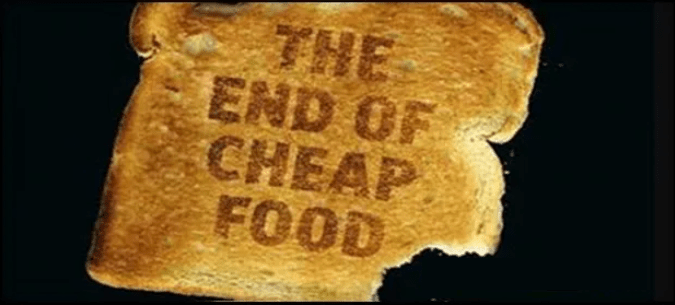
The End Of Cheap Food
Global food production rests on soil and rain. Robots don’t change that.
Of all the modern-day miracles, the least appreciated is the incredible abundance of low cost food in the U.S. and other developed countries. The era of cheap food is ending, for a variety of mutually reinforcing reasons.

We’ve become so dependent on industrial-scale agriculture fueled by diesel that we’ve forgotten that when it comes to producing food, “every little bit helps”–even small backyards / greenhouses can provide meaningful quantities of food and satisfaction.
Virtually every temperate terroir/micro-climate is suitable for raising some plants, herbs, trees and animals. (Terroir includes everything about a specific place: the soil type, the climate variations, sun exposure, the bacteria in the soil, everything.)
We’ve forgotten that cities once raised much of the food consumed by residents within the city limits. Small plots of land, rooftop gardens, backyard chicken coops, etc. can add up when they are encouraged rather than discouraged.
Let’s start with how disconnected the vast majority of us are from the production of the cheap food we take for granted. A great many people know virtually nothing about how food is grown, raised, harvested / slaughtered, processed and packaged.
Highly educated people cannot recognize a green bean plant because they’ve never seen one. They know nothing about soil or industrial farming. They’ve never seen the animals they eat up close or cared for any of the animals humans have tended for their milk, eggs and flesh for millennia.
The latest news is shocking!!!
Experts predict that an EMP strike that wipes out electricity across the nation would ultimately lead to the demise of up to 90% of the population.
However, this figure begs an important question: if we were able to live thousands of years without even the concept of electricity, why would we suddenly all die without it?
Most of us take the industrial scale of agriculture and the resulting abundance and low cost for granted, as if it was a kind of birthright rather than a brief period of reckless consumption of resources that cannot be replaced.
Small-scale agriculture is financially difficult because it is competing with global industrial agriculture powered by hydrocarbons and low-cost overseas labor.
That said, it is possible to develop a niche product with local support by consumers and businesses. This is the Half-X, Half-Farmer model I’ve written about for years: if the household has at least one part-time gig that pays a decent wage, the household can pursue a less financially rewarding niche in agriculture/animal husbandry.
Industrial agriculture includes many elements few fully understand. The shipping of fruit thousands of miles via air freight is a function of 1) absurdly cheap jet fuel and 2) global tourism, which fills airliners with passengers who subsidize the air cargo stored beneath their feet.
When global tourism dried up in the Covid lockdown, so did air cargo capacity.
I have to laugh when I read another article about some new agricultural robot that will replace human labor, as if human labor were the key cost in industrial agriculture. (Hydrocarbons, fertilizer, transport, compliance costs, land leases and taxes are all major costs.)

Left unsaid is the reliance of industrial agriculture on soil, fresh-water aquifers and rain. Irrigation is the result of rain/snow somewhere upstream.
Once the soil and aquifers are depleted and the rain become erratic, the robot will be tooling around a barren field, regardless of whatever whiz-bang sensors and other gear it carries.
Global food production rests on soil and rain. Robots don’t change that. What few of us who rely on industrial agriculture understand is that it depletes soil and drains aquifers by its very nature, and these resources cannot be replaced with technology. Once they’re gone, they’re gone.
Soil can be rebuilt but it can’t be rebuilt by industrial agricultural methods–diesel-powered tractors and fertilizers derived from natural gas.
Few people appreciate that the dirt is itself alive, and once it’s dead then nothing much will grow in it. Whatever can be coaxed from depleted soil lacks the micronutrients that we all need: plants, animals and humans.
Every organism is bound by the Law of Minimums: heaping on one nutrient is useless unless all the essential nutrients are available in the right proportions.
Dumping excessive nitrogen fertilizer on a plant won’t make it yield more fruit unless it has sufficient calcium, sulfur, magnesium, etc. All dumping more nitrogen fertilizer on the field does is poison waterways as the excess nitrogen runs off.
Irrigation is another miracle few understand. Over time, the natural salts in water build up in irrigated soil and the soil loses fertility. The drier the climate, the less rain there is to leach the salts from the soil. Irrigation isn’t sustainable over the long run.
Plants need reliable conditions to reach maturity. Should a plant or tree be starved of water and nutrients, its immune system weakens and it is more vulnerable to diseases and insect infestations. Yields plummet if there isn’t enough water and nutrients to support the fruit or grain.
Extreme weather wreaks havoc on agriculture, even industrial agriculture. A crop can grow oh-so nicely and reach maturity, and then a wind storm or pounding rain can destroy the crop in a few hours.
Most people assume there will always be an abundance of grains (rice, wheat, corn) without realizing that the vast majority of grains come from a handful of places with the right conditions for industrial agriculture. Should any of these few places suffer erratic climate change, then exports of grains will shrink dramatically.
Once cheap grains are gone, cheap meat is also gone, because most meat depends on grain feed.
The scale required to grow an abundance of grain is other-worldly. Much of Iowa, for example, is fields of corn and soybeans, a significant percentage of which becomes animal feed.
American tourists ooh and ahh over artisanal goat cheese in France or Italy without any appreciation for the human labor that goes into the artisanal food, labor that can’t be replaced by robots.
Industrial agriculture only works at vast economies and scale and high utilization rates. The 10-pound bag of chicken thighs is only $25 because tens of millions of chickens are raised in carefully engineered factory conditions and slaughtered / cleaned on an industrial scale.
Should the utilization rate and scale drop, the entire operation ceases to be economically viable.
Global industrial agriculture relies on exploiting low-cost labor forces and soil that hasn’t yet been depleted. This is why clear-cutting the Amazon is so profitable: hire desperate workers with few other options to earn cash money, stripmine the soil until it’s infertile and then move on.
There are many misunderstandings about industrial agriculture and the reliance on cheap hydrocarbons. Many pin their hopes on organic vegetables without realizing every organic tomato is still 5 teaspoons of diesel and 5 teaspoons of jet fuel if it’s grown on an industrial scale and shipped thousands of miles via air.
Much of the planet is not conducive to high-yield agriculture. The soil is infertile or depleted, and restoring it is a multi-year or multi-decade process of patient investment that isn’t profitable on an industrial scale.
As a means to make money, localized production can’t compete with industrial agriculture. But that’s not the goal. The goal is to replace dependence on industrial agriculture with our own much smaller, optimized-for-our-locale production, and grow a surplus that helps feed our trusted network of family, friends and neighbors.
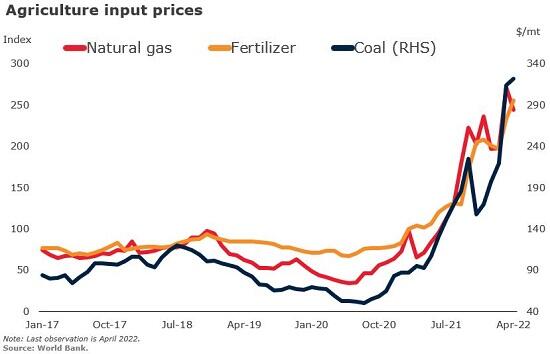
As industrial agriculture consumes the last of its soils and aquifers, hydrocarbons and mineral fertilizers are becoming costly, and as climate change disrupts the 50+ years of relatively mild, reliable weather we’ve enjoyed, cheap food will vanish.
Once the scale and utilization rates decay, industrial agriculture will no longer be viable economically or environmentally. This dependence on scale and utilization rates is poorly understood. We assume that somebody will continue growing our food on a vast scale regardless of any other conditions, but any activity must be financially and environmentally viable or it goes away.
As industrial agriculture decays, food will become much more expensive: even if it doubles, it’s still cheap to what it may cost in the future.
Due to our dependence on industrial agriculture, we’ve forgotten how productive localized (artisanal) food production can be. Small operations aligned with the terroir can produce a surprising amount of food.
The future of sustainable, affordable, nutritious food is in localized production optimized for what grows well without industrial interventions. The satisfaction and well-being this connection with the land and Nature generates is under-appreciated. It is not accidental that the long-lived healthy people among us–for example, the Blue Zones Okinawans and Greek islanders–tend their gardens and animals, and share the bounty of their labor with their families, friends and neighbors.
It’s fun and rewarding to grow food. It might even become important. Those who can’t grow any food would do well to befriend those who do.
The goal isn’t to replace industrial agriculture. The goal is to reduce our dependency on unsustainable global systems by reinvigorating localized production.
The most shocking article can be found below.
Liberal’s hidden agenda: more than just your guns…
… the impending collapse of the US food supply system
will steal the food from your kids’ tables…Watch this video below to find out the great secrets hidden by the government.
-
7 Survival Foods: Non-Perishables That Can Outlive You- Whether you’re sick of throwing out food that’s long past its expiry date, or are working on preparing a food stockpile in case of an emergency, consumables that practically never spoil
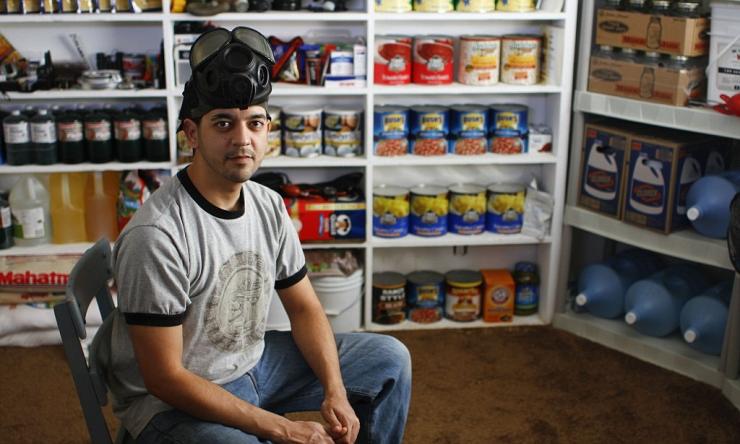
Whether you’re sick of throwing out food that’s long past its expiry date, or are working on preparing a food stockpile in case of an emergency, consumables that practically never spoil can be a huge asset to your household. This article lists non-perishable food items that not only have long shelf lives, but if taken care of properly, these foods stand a chance of never going bad within your lifetime.
These ideal survival foods will of course need to be stored the right way in order to retain their practically never-ending shelf life. The absolute best place to keep a food stockpile is in a dark, cool, and dry spot, free of humidity, moisture, direct sunlight, and extreme temperatures. Keeping consumables in an air-tight container, or better yet, vacuum packed, is also very important to increasing shelf life.
Although many non-perishable survival foods may change flavour and/or texture over the years, they remain edible and perfectly safe for consumption over indefinite periods of time. Use your senses to judge whether or not food with long shelf life has expired. If it smells off, has become too soft, or has developed mold, it’s better not to eat the item.

Best Long Shelf-Life Non-Perishable Food Items You Can Buy
Here’s just a small glimpse of what you’ll find in The Lost SuperFoods:
The US Army’s Forgotten Food Miracle And 126 Superfoods That You Can Store Without Refrigeration for Years

1. Staple survival foods that are non-perishable
You’ll need to be really careful about keeping these completely dry and free from moisture, but if you can manage to store these in air-tight containers, they will keep for an incredibly long period of time.
- Rice: white, wild, jasmine, Arborio and basmati (brown rice does not keep forever)
- Hardtack crackers/biscuits
- Dried cranberries
Here are 23 survival uses for honey that you didn’t knowabout.
2. Other survival foods that are non-perishable
Although some of these food items will change texture, thickening or hardening over time, they will only change in terms of taste. These survival foods never spoil, and will still remain edible long after their flavour has changed.
- Honey
- Molasses
- Maple syrup
- Dried lentils
- Dried beans
- Dried split peas
- Dry mix Jello
- Gobstoppers
3. Survival foods that if frozen are non-perishable
Though these non-perishable foods last a long time if they’re left out in the open, if they’re frozen, their shelf life extends to indefinite amounts of time.
- Dried pasta
- Noodles
- Dried fruits (such as raisins, dried cranberries, dried cranberries, dried cherries, dried apricots, dried mangoes, dates, dried blueberries, dried plums, banana chips, figs)
- Instant/freeze-dried coffee

4. Base ingredients that are non-perishable
Apparently, these base ingredients can be the perfect survival food. According to some sources, if you simply keep them unused, in an air-tight container and completely free of humidity and moisture, and you’re likely to never have to buy them again.
- Corn starch
- Baking soda
- Corn syrup
5. Seasonings that are non-perishable
Seasonings are also excellent survival foods, as they’re food that lasts forever, and only get weaker in strength of taste over long periods of time. Like with the base ingredients, keep these in an air-tight container, free of moisture and humidity, and they’re likely to never expire.
- Salt
- Sugar
- Pepper
- Spices
- Dried herbs
- Pure flavour extracts (pure vanilla extract, etc.)
(Here are 23 survival uses for honey that you didn’t know about.)
6. Condiments that are non-perishable
While these foods will likely change in taste after some time, they remain safe to eat indefinitely. The best way to keep these non-perishable foods is in an airtight container, free of moisture, and in a dark, cool spot, away from sunlight. This type of storage will keep your non-perishable food condiments tasting better for longer.
- Vinegar (white, apple, balsamic, raspberry, rice wine, and red wine vinegar)
- Worcestershire sauce (unopened)
7. Survival drinks that are non-perishable
Non-perishable drinks are another asset you can add to your survival food stockpile. Any alcohol over 10% that does not contain eggs, milk, and other dairy derivatives (ex. not Baileys, Tia Maria, etc.) should typically last forever in a stockpile. Alcohol also has disinfectant and medicinal properties, so keeping it stocked, especially when it never goes bad, is definitely a good idea for any prepper. Learn more about the best alcohol to stockpile here.
- Wine
- Spirits
- Liquors

Any Long-Term Expiry Date Food Items We’ve Missed?
Let us know if we’ve missed anything that should be on this survival foods list by leaving a comment down below!
The most shocking article can be found below.
Liberal’s hidden agenda: more than just your guns…
… the impending collapse of the US food supply system
will steal the food from your kids’ tables…Watch this video below to find out the great secrets hidden by the government.
-
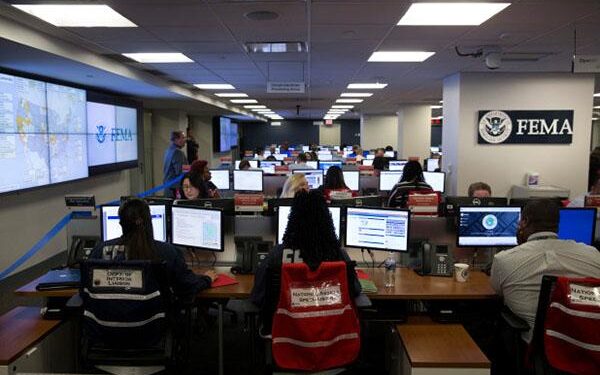
A once classified FEMA report has surfaced and goes in depth on the level of preparations and concern that they have for a storm of this magnitude.
Forward thinkers are always ostracized. It has been that way throughout history. Preppers are no different. We just ought to be thankful we are not living in the time of Socrates, or else we would be lining up for the hemlock.
From large scale civil unrest to the one of an EMP generated by the sun, it’s clear that preppers have been way ahead of their time. These topics were once deemed “paranoid”, or “delusional” but all of the sudden names in pop culture and even world governments are paying attention to these types of threats.
One such threat seems to be leading the pack and has shown up in many recent government reports. FEMA in particular seems to be concerned about the threat of a geomagnetic storm that would emanate from the sun and cause massive power outages across the planet.
A once classified FEMA report has surfaced and goes in depth on the level of preparations and concern that they have for a storm of this magnitude.
Understanding Reports and Unpublished Documents
The government buys ammo, writes and drafts lots of reports and documents that never really see the light of day. Now, we must be smart about that bit of information.
It’s important to take a look at these for what they are. There is a lot of research and science that goes into creating these drafts and reports. They are not a bunch of made up steps and stats.
However, some of these reports are also never going to be acted upon. That means, though the report may contain some very effective information, it’s not going to affect law or protocol in any way.
To be completely clear, what we have here is an unpublished document that was written by FEMA. It contains some very important information that confirms the government’s understanding of the EMP threat posed by our own sun.
The title of this unpublished report is very telling.
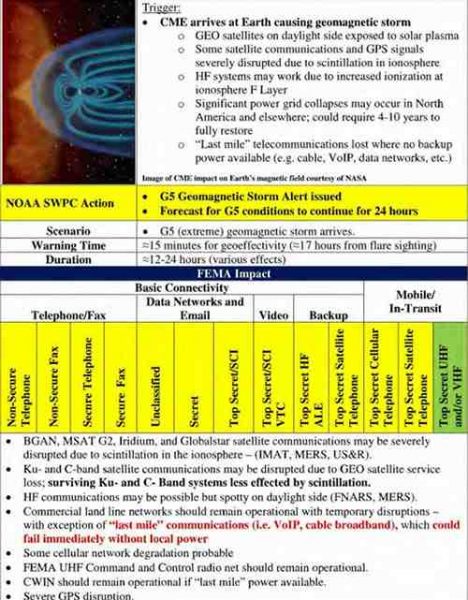
Mitigation Strategies for FEMA Command, Control and Communications During and After a Solar Superstorm
FEMA and NOAA’s Geomagnetic Storm Timeline
There are many takeaways from this classified FEMA report, but the geomagnetic storm timeline is the core of this document. This timeline shows that this report was put together with a tremendous amount of research and a focus on following the solar superstorm, from its start as a sunspot all the way crashing into the earth’s atmosphere.
G Minus 5 Days
This is the first spotting of the large sunspot on the surface of the sun. The focus is on large, complex magnetic fields on the surface of the sun. From this point we would have a 5 day window to prepare, but it would be very hard to determine the threat at this point.
G Minus 17 Hours
At the launching of a massive CME we are left with just 17 hours to prepare. Radio, radiation storms and geomagnetic storm warnings and watches are also issued at this point.
G Minus 16 hours 40 minutes
The solar radiation storm arrives at this time and we lose 15% of our satellite fleet due to solar panel damage. There could be greater loss and efficacy issues with GPS.
We would have about 20 minutes notice before this happened. “We” doesn’t necessarily mean you and I would hear anything.
G Minus 15 minutes
CME arrives at the NASA ACE Satellite.
There is no going back from this point. This is basically the point when we have an EMP on our planetary doorstep.
0 Hour
Services Interrupted
At the heart of the EMP fear is the loss of services. We all know that once shipping stops things get ugly fast. When the food and medicine are no longer being shuttled around the nation, people get hungry and desperate.
Water systems will also be affected by an EMP. Much of the process that cleans your water is governed by computers and machine systems. Those go away, too!
In this report they discussed something that was very interesting in terms of communications and infrastructure. It is called the “Cascading Loss of Last Mile Telecommunications over Time”. It’s a terrifying look at how over the span of 8 days all communications will fall, starting with communications from home telecom lines.
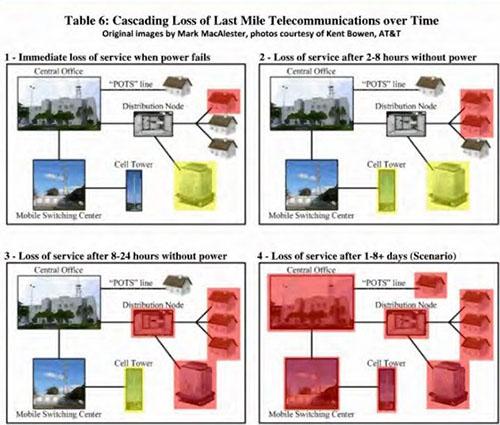
The diagram below offers up a telling scenario where this cascading loss takes its grip starting at the residential level and working its way through to the Central Office.EMP Recovery
The infrastructure needed to tackle EMP recovery is expensive and hard to make. That’s the deal. We are talking about things like oil cooled transformers that are 60,000 a piece and require special equipment to move around.
Special equipment that will likely not be EMP proof!
Recovery from an EMP is something of a pipe dream if we are honest and if the whole nation is affected. Maybe the military could bring up sections of the grid at a time, or maybe not. However, it really is more of a countdown on human life.
The survival of our society will depend on how many people die in the time it takes to recover from that EMP.
What to Make of all This Reporting?
There are two big takeaways from all these documents coming to light, research being done and even Donald Trump bringing the threat of an EMP to the forefront.
#1. People are Paying Attention
While we can all agree that our bloated government is full of people looking for a way to bide their time and get another day closer to pension, this keeps coming up. Grid down situations are a concern in the halls of government. I don’t think we can deny that.
Even the most cynical of us must agree that without electricity it gets much harder to collect taxes.
How far they will go to take action against an EMP threat is another thing entirely. However, we also have to be honest about our responsibility in this.
We the people cannot bray about small government all day and then complain that they aren’t 100% prepared to assist the public following a total grid down situation.
#2. A Prepper’s Responsibility
The second and more important takeaway from this report is that we have a responsibility to prepare and get as many others prepared as possible.
A widespread grid down situation is going to kill anyone who is not prepared for it. It’s even going to kill tons of people who are prepared for it. Now is the time to take action and make your action known. I really believe that us, preppers, can influence the world positively.
People might seem put off by the message but, trust me, they go home, and they think about putting up their own food and being ready for when disaster strikes.
-
Your Weapon Is Only Tool to Survive: Military Gun Fight Tactics (90% of a good tactician’s skill is how the deploy and utilize information from recce, with the other 10% being a good leader with good interpersonal skills and the ability to keep cool under pressure.)
Do you know how to survive a gun fight?
Here’s the situation: some people want your stuff, or they just plain out want to kill you. Whatever the cause of the escalation might be, all you’ve got is a gun lying on the ground next to you. What shooting techniques and tactics would you use and how would you survive a gun fight?
So first, you’ve picked up the gun, pulled out the magazine and checked how many rounds you’ve got spare. This is all while rounds are flying over your head and bouncing off things around you. But they’re not hitting you because you’ve already ducked behind cover to figure out your tactics right?
Let’s just say that if there were a group of people firing at me, my first thought would be to get out of there as quickly as possible, regroup with some gun-savvy would-be John Wick volunteers and come back. One big tip that might help, in a gunfight, 3 on 1 is better than 1 on 3. So work with those odds and round up some friends who would be worthy of a gun fight and are up to scratch with these 14 things to remember to survive a shootout.
Important below:
Today I’d like to share with you a “3-second survival hack” you can use to skyrocket your chances of protecting your loved ones during ANY crisis.
This technique is so powerful it can give you almost superhuman powers during the ugliest nightmares imaginable….
From natural disasters like earthquakes or tornadoes…
To explosive situations like mass shootings or even nationwide martial law.
And It doesn’t matter if you’re out of shape…
Or have no equipment…
Or even if you’re disabled living in a wheelchair.
This technique has been tested and proven by elite soldiers and real world “miracle” survivors from around the world.

1. Have yourself a merry little sidearm pistol
Weapon fires weapon stops. This is a thing they teach to soldiers in initial weapons training. They teach this because guns are not like a weapon in Call of Duty, in a real gun battle they stop. You could fire one shot and the weapon might not automatically reload because you have a chunky piece of metal 5.56 jacket jammed in your ejection port.
Now while any good shooter might pull out the magazine, cock the weapon and give the gun a right old nudge and shake just to free up the jam, you’re not going to do that. In an immediate jam, you are going to sling that weapon (everyone should have a good adjustable sling) and whip out your pistol to keep firing.
You might have seen John Wick make his way through a soiree of larger weapons before working his way down to his pistol range, that’s because when you’re in the heat of a shootout, using your next loaded weapon is quicker than fixing a jammed gun, or doing a magazine change.
That pistol is your merry little backup present when the first one wasn’t good enough. It is loaded and ready to dump out the 15-30 rounds you might be carrying in your glock magazine.
In this case, you’d probably use this secondary weapon to work your way through a pistol fight while you find cover and get your boomstick back into the game.
For a demonstration on the quick sling of the primary to secondary weapon, we can look no further than to the training given to Keanu Reaves to become John Wick by Taran Tactical for this one:
2. Know where your ejection port is
While we all love the John Wick films and other great shooting movies, those films aren’t always that accurate. Especially when it comes to bullet casings. Every weapon has an ejection port. Out of that comes the bit of bullet that never leaves the barrel of a gun. It’s called a casing and it is damn hot.
The first reason you should know where your ejection port is would be in the case above where your weapon jams up. Most of the time it’s going to be a bullet that hasn’t been struck properly and has not fed into the gun correctly, you will see this stuff up in the ejection port. It is about this time that if you are only carrying one gun, you should know how to fix a weapon jam pretty quick.
The second reason, and one quickly learned by shooting beginners, is that some weapons have ejection ports that can fire hot bullet casings onto your skin causing a nice little bullet tattoo to be burnt into your skin. Generally, the ejection port is on the right side of the weapon, so when your would-be volunteer buddies in the gun fight are on your left you are going to get sprayed with burning hot bullet casings.
What should you do about this? Suck it up. They’re on your side and you’ve got bullets coming at you. But if you’re like this lady with a bullet casing down the top, you’re probably going to be burning.
3. I shoot, you run
If you are not shooting you should be running. Tell your buddies in the gun fight the same thing. Try to synchronize it. If you are retreating, one person shoots while the other runs, repeat this until you are in your abandoned building, bunker hideout.
This works the other way, in the attack. If you have sized the enemy as being reasonable for your capacity and you decide to attack, shoot in their direction while your buddy runs. Let’s hope he is smart enough to figure out he should do the same.
The process of your buddy shooting while you run is called ‘covering’. This is why you hear that great term, covering fire.
This gunfighting technique also referred to as ‘fire and movement’ and if you’ve been in the military you’d cringe just hearing these words as that is a lot of the combat practice in the field which turns to elements in urban training.
When you are making those shots, sure, rounds placed near an enemy’s position is going to keep them pinned behind cover, but make sure you control your breathing, which in turn helps with your aim. The military uses a method called Box Breathing for this. Learn it and use it as it is a great way to de-stress and take control of any given situation.
4. Keep your eyes on three things at the same time
While you are ducking, diving, and firing well-aimed shoots in your gunfight survival, there are three other things (I know, it’s a lot) that you should be paying attention to: the guys shooting at you, your buddy, and possible cover. These three things are the only things you should be looking at. You should be watching where your enemy is, where you last saw them or where they sound like they are shooting from. You should be watching this because when your buddy is moving, this is where you are shooting.
You should be watching your buddy and listening out for his gun. If he is shooting, you move, if you don’t hear any shots from him, that probably means his weapon is jammed or he is just plain useless. In some cases that uselessness can also cause a jam – be warned.
On top of this, you should always be looking for the next place you are going to move to. If you are in a retreat, this is basically putting solid things behind you, if you are attacking, this is stuff in front of you. Always be looking for covering spots. Why? Because the next point is why.

5. I’m up, he sees me, I’m down
This is what you say when you run. As soon as you take your first step you should say to yourself: “I’m up, he sees me, I’m down”. This is enough time to move, and not allow your enemy to take a steady aim and kill you. If you run longer than this, anyone with a sense of aim can take a quick sighting and put some metal your way and possibly land a hit. So don’t let it happen.
When the phrase says ‘down’ this doesn’t just refer to dropping to the ground, it is whatever you deem a safe place to fire from. If it is a wall or over the front of a car, use it as cover and shoot while your buddy moves.
You can see how these guys from Polenar Tactical work in unison to provide covering fire for their buddy running. Eventually, this would get you close enough to the enemy to grenade them, or get closer to get your buddy in a flank.
This phrase is something that is regularly repeated in initial combat training for a lot of the world’s forces. It is taught for the reason which is to keep you alive. But this will fail you if you don’t adhere to the next part, which is once you are down, move for an extra few meters. Why? Next point.
6. Don’t be a rabbit
Ever seen a rabbit in the grass? It bends down to eat, pops its head back up and bends down again. You give your friend a nudge in the arm and say “check out two meters left of that tree, there’s a rabbit”. And before you know it, the rabbit has popped his little head up in the exact same spot. Boom, if you were the rabbit you would be dead. The same will happen in a real gun fight.
In a shootout, if you see someone running you are going to aim at their last seen place and wait until they pop out to shoot them. So with the principle mentioned before, once you leave the visibility of your enemy whether it be behind a car, wall… or whatever, move and crawl a few meters before popping up to shoot. Make sure that movement is lateral to the enemy. Think of it as getting out of the X.
In an urban environment, this can only work so well as you might be behind a car or a single-spaced object with very little crawl distance. Make do with what you can but remember the idea of the rabbit popping up in the same place.
7. Be aggressive and quick
Let’s think about some animals at the top of the food chain. All of the ones that I can think of are aggressive and quick in their attack and you should be too despite whether you are attacking or retreating. Why? When you are covering fire you only have a certain amount of bullets to do so (You are hoping that we picked up a gun with a full mag when we found it at the start).
Taking a gun fight slow and steady will result in getting shot. Bullets move fast and you need to as well. If you are ever unfortuante enough to find yourself in the midst of a real gun fight the number one rule is to be aggressive, confident and quick.
Part of being aggressive is also being on the offensive. When it comes to surviving a gun fight, when you maintain the offensive with your buddy (hopefully more than one) you are overwhelming your enemy with so much precise force that they cannot handle the pressure and start making mistakes and panic. This puts you in control and control is the key to winning.

8. Plan like it’s the last thing you ever do
Yes, it could be the last thing you ever do. Getting shot is no field trip and it can result in a massive loss of blood and death. So what are you going to do? Well, you should already have your answer for that. Plan, plan, plan.
It could be anything from attacking with your buddy up until you can run a flank, or it could be to sit and fire a few shots in the enemy’s direction to probe and find out what sort of guns they have (let’s hope for your sake they don’t have mounted heavy belt-fed weapons). Whatever you do, have a plan and a backup one if that fails.
When it comes to gun fights, there are a huge amount of tactics that can be employed, they all depend largely on the area where you are fighting, such as urban gun fights in buildings, apartments and tight streets, or in the wilderness in forests, jungles or wide open planes. All of these have their setbacks, exposure points, and weaknesses. The only way to win a fight is to think logically and exploit those weaknesses against the other team.
I recently wrote a post about a tactical way of thinking using situational awareness. The theory of the OODA loop was developed by a military tactician and is something you should use to diagnose, dissect and win your gun fight. The OODA loop is explained in-depth in the post on situational awareness but for an overview, it stands for:
- Observe your enemy
- Orientate how they are acting and what you can do to counter and win that action
- Make a Decision on the best course of action to take
- Carry out the Action.
- The loop then continues back into the observation phase.
9. Be fit for a gunfight
By this, we don’t mean you should start doing pushups in the middle of a two-way range. This is a preparatory thing and is a big part of prepping for when the sh-t hits the fan. Fitness is important in a gun fight for three main reasons:
- It keeps you confident with a level-head and tactical thinking mindset
- It gets you from point A to B quickly and efficiently
- It allows you to make a steady aim after just sprinting for your life
If you are not fit, get started by working with high-impact interval training.
10. Get creative when looking for cover
Cover isn’t just a place to hide, it’s also a place to shoot rounds from to try and land a hit on your enemy as well as to suppress the enemy for your buddy to gain some ground. Part of this involves the flexibility and creativity that many special forces soldiers use in their field office. Chances are your gun fight is going to be in an urban environment which means you are going to have vehicles, houses, fences, garden hedges, windows and anything else at your disposal. Whatever you have got, use it.
Navy SEAL Rich Graham teaches various methods like this at his Tactical Carbine course. While this video was intentionally about muzzle awareness from a concealed position, you can see how he uses the tray of a truck as a covered firing position.
Remember that whichever position you find to fire from, make sure you can build a solid firing position to aim, control your breath and control your weapon so that you can make more accurate shots. These are simple military marksmanship principles and greatly improve your aim ability to end a firefight with a well-placed shot when coupled with breathing exercises taught to soldiers. For those that find they need to take time to line a good shot on the range, there are courses developed online such as the Spec Ops Shooting Course that teaches you how to shoot faster while still maintaining the same accuracy. When it comes down to it, shooting quick, and accurate is the most important shooting technique you can ever master.
11. Bring a knife to a gun fight
You have probably heard something along the lines of “don’t bring a knife to a gunfight”, but that is completely wrong. A knife is a piece of equipment every tactical gun fighter should have on their kit for a number of reasons. One of them is that a knife something you can grab in close combat when everything else fails.
Remember how we said you should have a merry little sidearm? What if you have spent all of that ammunition getting to the enemy and it comes down to a test of strength between the two of you? No, that’s not going to happen. You’ve got a fixed-blade knife ready to use in combat.
What type of knife should you be using? That’s up to you, but as far as cool gear goes, you can’t go past the legendary US Marine Ka-Bar knife.
12. If you are entering a gunfight in a car, shoot, then get out and shoot some more
Cars are bullet magnets, and you are pretty well exposed if you are sitting in it (unless of course, you are in the US President’s Beast), so you are going to need to get out of that thing quickly. But while you are getting out, you could be sprayed with metal.
To leave a car in a gun fight (assuming it has stopped) you should:
- Fire some shots at whoever is shooting at you (this will divert their attention from shooting you to ducking)
- Open the door and hold it open with your foot (some doors have a kickback)
- Lead with your gun out the door aiming at the enemy and fire shots while leaving the car
- Position yourself so that the vehicle is in between yourself and the enemy
Here is a demonstration on executing a quick departure from a car under fire from Tactical Rifleman:
13. Don’t forget your chest rig

Okay, so if you are in a gun fight, chances are you were probably looking for one and did not run away at the first sign of a shot. This means you are a hardened individual ready to eat lead, shoot with precision, advance towards an enemy and make them quiver with fear from your dominant fighting skills.
All of this means you probably already have something like a Condor Recon Chest Rig and the sweet sidearm carrier the Condor Tornado Tactical Leg Holster. You are a dangerous gunfighter by the looks of it. And with this gear you can carry more magazines, have the smaller working space between the quick draw of your magazines to the loading port of your rifle and handgun and you can also fasten the previously mentioned US Marine Ka-Bar knife to the molle on the rig.
If you are are anything of a military buff, you have probably heard of the film Lone Survivor, the film adaptation of the amazing story of war hero Marcus Luttrel. The film’s immensely real adaptation of military tactics, weapons drills, and equipment was very real. In saying that, the specialist Rhodesian Recon Vest (RRV) chest rig the character wore in that film is also a very popular option for many military professionals and security workers.
14. Don’t get in one, but if you have to, win.
Remember how we mentioned the OODA loop in Number 8? Well if you can see an opportunity to de-escalate an issue then take it. Peace is a much better approach for all parties than exchanging fast and hot bullets.
If there is a peaceful option to take, then take it. But if there isn’t then god speed.
In writing this article, I also encourage anyone who is interested in weapons, in general, to promote gun safety to anyone you know who is about to touch a weapon otherwise you might end up being injured by one of these unsafe people. While this post might sound light, guns are no joke and are meant to be taken very serious when working with and around them.
I hope you enjoyed this post. Give it a share with the buddies you would expect to back you up in a fight!
-
Global War- All Bets Are Off! (Tyrannical Great Reset Ruler/Serf Societies Planned to Replace The Existing Order, Worldwide The Ultimate Goal.)

Both wings of the US war party pose an unparalleled threat to everyone everywhere — undemocratic Dems most of all.
Count the ways.
Dems usurped control of the White House and Congress by indisputable brazen election rigging.
And humanity is paying the price at home and worldwide.
At home, throughout the West and elsewhere, US dark forces and co-conspirators target what little remains of greatly eroded freedoms for elimination altogether — tyrannical Great Reset ruler/serf societies planned to replace the existing order, worldwide the ultimate goal.
Far and away more than its predecessor, the Biden regime is going all-out to eliminate millions and billions of unwanted people domestically and abroad by poorly tested/experimental kill shots designed for this purpose — while more greatly enriching Pharma profiteers and the privileged few throughout the US/West.
Noted physician I’ve quoted time and again for his straight talk truth-telling on all things health related — Dr. Vernon Coleman — minced no words days earlier, saying the following:
“(W)e have a horrifying avalanche of (indisputable) evidence (based on science to show) that these damned (jabs) are killing and maiming people – all for a disease which is proved to be no more dangerous than the annual flu.”
What I call seasonal flu/influenza renamed, Coleman added:
What’s going on “is (state-sponsored) global genocide.”
“How much longer are people going to be silent?”
“How many must die?”
“How many must be crippled” by experimental DNA-altering jabs?
Indisputable evidence shows that they risk contraction of most imaginable form of disease and disability — while providing no health protection as falsely claimed.
“It was obvious (long ago that mass-jabbing for flu/covid) would kill and injure millions,” Coleman stressed.
Pushing them and all else flu/covid related — notably by Dems and their MSM press agents — constitute a major Nuremberg Code breach.
It’s unequivocal stating that “voluntary consent…is absolutely essential” on all things health related, nothing mandated.
And “(n)o experiment should be conducted where there is an a priori reason to believe that death or disabling injury will occur.”
And “experiment(s) (when) conducted…should…avoid all unnecessary physical and mental suffering and injury.”
Yet CDC and European Medicines Agency data show over 7 million injuries and deaths since mass-jabbing began — reported figures a small fraction of the real human toll.
There’s no ambiguity that heavily promoted and/or mandated kill shots constitute a major Nuremberg Code breach.
In the US, Dems are far and away the main offenders.
Weeks earlier, researcher Steve Kirsch stressed the following based on indisputable scientific evidence, saying:
“The ‘safe and effective’ narrative is falling apart.”
Deaths and life-altering injuries from kill shots are “too massive to keep hiding (and) explaining away.”
“How can heart disease explode in kids only” after getting jabbed?
“Embalmers are seeing blood clots in over 50% of patients that they’ve never seen in their careers.”
“(D)eaths from stroke and other unusual causes in YOUNG people are through the roof.”
Jabbed children are “having seizures.”
“(B)irth rates are dropping (worldwide) and there are more stillbirths.”
“Young people (are dying) in their sleep.”
So are large numbers of highly conditioned athletes while or after competing on the field of play.
“Pilots are having events at unprecedented rates, but airlines (aren’t) screen(ing) (them) for cardiac issues.”
“Young healthy (people) are having medical problems at unprecedented rates.”
Medical professionals-turned whistleblowers are speaking openly about health destruction from kill shots — at the risk of their careers being terminated for the offense of truth-telling compliance with Nuremberg Principles and the Hippocratic Oath of doing no harm.
It’s scientifically clear that flu/covid jabs are unsafe at any dose.
That multiple jabs significantly risk irreparable harm to health.
That MSM continue betraying the public welfare by heavily promoting what should be banned.
The NYT is one of the leading offenders with rubbish like the following, saying:
Garden variety flu renamed covid killed “nearly 15 million people (sic).”
A raging pandemic of the jabbed exists — not the other way around.
Staying unjabbed is crucial to protect what’s too precious to lose.
And this Times rubbish:
The Pharma-controlled FDA “authorized (a) redesign” of kill shots for more scariant than variant omicron — what’s crucial to shun with protecting health in mind.
All flu/covid strains are virtually identical, differences among them too minor to matter.
Instead of explaining what’s important for everyone to know — notably about shunning health-destroying jabs — the Times and other MSM push them in cahoots with genocide-supporting Dem dark forces.
Along with heavily pushing health-destroying kill shots with unparalleled depopulation in mind, the Biden regime, congressional Dems and likeminded Republicans risk war on Russia over Ukraine and on China over Taiwan — with nukes if things are pushed too far.
Never before in my lifetime was I more fearful of what may lie ahead than now — with criminals empowered in Washington, other Western capitals and Tel Aviv.
Two devastating global wars taught nations involved nothing.
Compared to the power of today’s super-weapons, ones used in WW I and II were toys by comparison.
If global war 3.0 occurs, all bets are off.
What’s unthinkable could be war to end all future ones by eliminating humanity and all other life forms.
-
The Worst Is Yet to Come- “If history repeats,” what’s highly likely, “the play will once again be a Tragedy,” Grantham explained.

Longtime investor/money manager, Jeremy Grantham, is noted for straight-talking, scholarly market assessments.
(W)e live in a mean-reverting world in investing,” he once said.
All bubbles revert to their median valuation — “no exceptions ever.”
Often before at this level, they fall well below it.
On August 31, Grantham published his latest assessment of market conditions, titled “Entering the Superbubble’s Final Act,” explaining the following:
“Only a few market events in an investor’s career really matter, and among the most important of all are superbubbles…events unlike any others.”
One reoccurring feature “is a bear market rally” after an initial sharp decline.
“(U)nwary investors (are) lur(ed) back just in time for the market to turn down again, only more viciously, and the economy to weaken.”
“This summer’s rally (now ended) perfectly fit the pattern.”
Even after declining sharply, “(t)he US stock market remains very expensive” at a time of soaring inflation, what “always hurts multiples.”
And “now fundamentals (are) deteriorat(ing) enormously,” Grantham explained.
They include another economically and socially destructive lockdown in China, what’s harming over 20 million people.
It certainly doesn’t protect anyone anywhere when instituted, indisputably the opposite.
Market fundamentals are also harmed by “food and energy crises, record fiscal tightening, and more,” said Grantham.
What hindsight one day may call the mother of all superbubbles includes “an unprecedentedly dangerous mix of cross-asset overvaluation (with bonds, housing, and stocks all critically overpriced and now rapidly losing momentum), a commodity shock, and Fed hawkishness.”
“Each cycle is different and unique – but every historical parallel suggests that the worst is yet to come.”
Times like now matter most for investors because they’re treacherous, Grantham stressed, adding:
It’s important to understand that the higher superbubbles go, the further they have to fall.
They break in “multiple stages.”
At their peak level, “a setback occurs,” what happened in Q I and II this year.
A “bear market rally” follows at some point, usually regaining half or more of losses incurred.
“(F)inally, fundamentals deteriorate and the market declines to a low.”
Examples of US bear market rallies include the following, Grantham explained, saying:
“1. From the November low in 1929 to the April 1930 high, the market rallied 46% – a 55% recovery of the loss from the peak.”
“2. In 1973, the summer rally after the initial decline recovered 59% of the S&P 500’s total loss from the high.”
“3. In 2000, the NASDAQ recovered 60% of its initial losses in just 2 months.”
“4. In 2022, at the intraday peak on August 16th, the S&P had made back 58% of its losses since its June low.”
At market peaks, economic conditions look rosy.
That was the state of things in 1929, 1972, 1999, “and in Japan (the most important non-US superbubble).”
“The aging cycle and temporary near perfection of fundamentals leave economic and financial data with only one way to go.”
What can’t go on forever never does, and what goes up inevitably comes down.
At this time, after an initial superbubble-bursting decline and bear market rally, “the fundamentals are far worse than expected,” Grantham stressed.
They include economic trouble in China where “too many things are going wrong at the same time (in a nation that) carried by far the biggest load of global growth for the last 30 years.”
And there’s real estate weakness throughout the US/West and elsewhere.
“Historically, real estate has been the most important asset class for economic stability,” Grantham explained.
And this reality check, saying:
“Previous superbubbles saw a much worse subsequent economic outlook if they combined multiple asset classes,” including stocks, bonds and housing.
“(O)r if they combined an inflation surge and (rising interest) rate shock with a stock bubble.”
“The current superbubble features the most dangerous mix of these factors in modern times.”
The three major asset classes – housing, stocks, and bonds – “were critically historically overvalued at the end of last year.”
And now there’s soaring inflation, rising interest rates, and “commodity shocks” caused by shortages and high prices.
“If history repeats,” what’s highly likely, “the play will once again be a Tragedy,” Grantham explained.
-
THE PICTURE ILLUSTRATING THIS ARTICLE SAYS IT ALL! The 6 Golden Rules of Surviving Martial Law: America – the greatest nation on earth – is currently facing unprecedented times of social unrest, and dare I say, this is just the beginning. (Republished in 2021 and improved)
America – the greatest nation on earth – is currently facing unprecedented times of social unrest, and dare I say, this is just the beginning.
Regardless of who presides over the nation, we should always be aware of the so-called “shadow government” and their agenda. And mark my words: Our nation is in for times of massive unrest that were being plotted as early as 2015 and will continue until the “global agenda” pursued by George Soros and his allies is implemented. The coming out-of-control riots may lead to a call for Martial Law, as I will explain.
America has been preparing for massive social uprisings for a very long time (a quick research on the topic will reveal this truth). What I am about to tell you next might come as a surprise for some of you, but most of the things that we experience are being manufactured.
Never in my lifetime have I seen America so divided.
Our politicians and the mainstream media have been endlessly pitting various groups against one another for years, and everywhere you look, hearts are growing very cold.
Trump’s victory has come as a surprise for many, but if we consider the new state of play of the world, where the economic crisis has led to global divisions driving, thus, a return to national interests over the global ones, voting for Trump has been the obvious choice. During difficult times, we must safeguard the values and interests of the American people. But manufacturing nation-wide protests during confusing times may be just what some might wish for in order to divide and destabilize the country in exchange for the ability to control us at all times. In case we don’t comply with their “desires” we will face dire consequences, as the infamous Zbigniew Brzezinski, the imperialist/globalist/war-monger and former policy advisor to Obama, said:
“Today, it is infinitely easier to kill a million people than to control a million people”.
After some extensive research on the matter, I am inclined to affirm that what we’re currently experiencing is just the beginning, and the protests are rapidly turning into violent riots. Although many commentators are claiming that martial law will not be declared, we can never be sure of what is being planned for us.
Did you know that if martial law is declared, Trump will be prevented from taking office?
Returning to the fact that Soros is behind most of the protesters’ actions, we must acknowledge that the fundamental reason for inciting violence is to create favorable circumstances for the President to legitimately institute martial law if the riots continue on the same path. This is how it will work:
- The current protests are spreading rapidly, and when there is an increase in both violence and numbers, this movement will inevitably grow into a national riot.
- If needed, due to extensive clashes, martial law will be declared. Therefore, when this happens, Trump will not be able to take office because Obama will stay in power for however long is necessary until the “National State of Emergency” has passed (Bernstein), (AMBELLAS). There is a good chance that this has been the back-up plan for some liberals all along (as mentioned earlier, there’s proof the protests are being staged) in order to further advance the globalist agenda that has been denied by our President-elect Trump.
So, here’s a glimpse of how life will be when martial law comes into effect:
- Everything we own can become federal property (especially guns and food stockpiles, which will be the first to be confiscated).
- Curfews will be the new normal, while groups of armed men and women will patrol the streets at all times.
- Access to food, water and other resources will be rationed. If your life depends on a daily dose of medication, you should start storing it in advance.
- There will be sky-high inflation, and with a national debt of almost $20 trillion, the stage is set to sky-rocket a new financial crisis that will make the 1930s Depression look like a walk in the park.
- Everyone will be considered suspicious. A short chit-chat with your neighbor about the “wrong” things can put your life on the line.
- There will be no access to free Internet, while free press and the freedom of speech will be things of the past
The 6 Golden Rules of Surviving Martial Law
Prepper or no prepper, these are the 6 Golden Rules to follow if martial law comes to your town:
1. First and foremost, talk with no one and trust no one.
Although the clear majority of preppers are already set to outlast any scenario that cuts them off from all the common supply lines, we must remember that under martial Law, everything that we own is able to become government property. Therefore, do not tell people about your supplies or secret hide-outs. I know it’s hard not to brag about your preps, but be careful to whom you’re talking
2. Always renew your supplies and make sure you have a “basic martial law survival kit.”
A basic martial law survival kit would imply the following: electricity generator, water filters or even water generators (H2O Dynamo), weapons, food supplies for six months, first aid supplies, clothing for any type of weather, a flashlight, batteries, radio gear, and navigation equipment. Of course, you’ll need these if you want to stay put. If you want to go outside and face the music…that’s a different story.
3. Avoid getting in the way of law enforcement or the military.
Even though some would advise that we be resilient to any violations of your constitutional rights, which, by the way, will be justified under martial law, the best survival tactics are to keep your cool and think before you react. You can always choose to fight back. These two options – bugging in or bugging out – will cause you to probably face the hardest decision of your life.
4. Tune in and be up to date with the news.
It is crucial to stay informed and keep in touch with whomever you consider important. Every media outlet, as well as the Internet, will be controlled by the federal government, and you will not have access to any other information except what is being communicated by the state. Although this might be upsetting, you still need to know what is going to happen so you can be prepared for any situation.
5. Cautiously develop a survival network.
Establishing a survival network would be an excellent idea considering the fact that we can never know for how long martial law will be imposed. Consequently, setting up a diverse group of preppers will ensure your long-term survival. But make sure you keep a low profile so that you and your group will not be targeted as perpetrators.
6. Inspect and know your surroundings by heart.
You should be able to visualize your home turf even in your sleep. Ideally, you would also have a safe room. Make sure you have a blueprint of your area where you mark the closest escape routes, develop the quickest itinerary to a safe haven, and formulate the best and safest evacuation strategy.
Share this:
-
Subscribe
Subscribed
Have a WordPress.com account? Log in now.